|
The Traitor
IX Count Ferdinando da Siracusa rides east with
a hard-on and a hangover. It’s always like this: mornings that taste
like blood, saddle-raw thighs, and an erection that pounds with the pulse of
the fever. The sun is already up, fat and ugly as an Arab merchant’s
wife, and the dust hangs thick over the valley like a smothering shroud.
Ferdinando cracks his neck, spits into the wind, and adjusts the sackcloth
around his balls. He’s never liked horses. They stink, they chafe, and
they die too easy. Bertrand rides beside him. The Templar looks half-dead already, the
lines of his face plowed deeper by three days of riding and at least two
nights with no sleep. His nose is twice broken, lips split, hair filthy and
matted into ropes. Bertrand’s surcoat, once
white, is piss-yellow and rust-red, and the black cross on his chest is
blotted with God knows what. He grins at Ferdinando, teeth like wolf fangs,
and says, “You’re leaking, you Sicilian fuck.” Ferdinando grunts, looks down, and sees the dark stain spreading over
his breeches. Not blood. Not yet. Just morning seed, another night’s
dream pressed into cotton by the sway of the horse. He wipes it away with a
laugh. “Better to leak from the cock than the throat, templar.” Bertrand hawks and spits. “You’d know. You Sicilians take
it both ways.” “Don’t say it like it’s a sin.” Ferdinando
bares his teeth, and his voice rasps like a blade over stone. “Your
mother took it both ways, and she was a fucking saint.” Bertrand laughs, a dry rattle, and slaps Ferdinando’s shoulder.
“You get funnier the closer you get to Jerusalem. Nervous?” “Nervous my balls. I’m itching for a fight. It’s
been too long.” He glances at the road ahead, winding up toward the
city on its pale hill, and shakes his head. “If the bishop’s
actually got some balls, he’ll send us to hold the gate.” “He’s got balls, all right. Brass ones, hanging in the
cathedral like relics.” Bertrand stretches, back cracking like dead
twigs, and spits again. “I just don’t trust him.” “No one trusts a bishop.” Ferdinando eyes a distant column
of smoke, thinks of the garrison they left behind two days ago, all those
broken men and wild-eyed boys trying to fuck away their terror in the
brothels of Jaffa. “What’s he want with us, then?” Bertrand’s mouth curls. “What do you think? Two men
survive Hattin when everyone else gets butchered or dragged off in chains?
We’re either heroes or traitors. And you don’t look like a hero,
Count.” Ferdinando’s knuckles turn white on the reins. “You want
to talk about Hattin, we talk about it. You pissed yourself when the Arab
horse broke our flank.” Bertrand shrugs, unashamed. “Better to piss myself than shit the
grave like Montbard.” “Montbard was a corpse before the end.
You and me—we fought.” The Count’s voice softens, just a
little. “We’re alive.” Bertrand grunts agreement. “For now.” They ride in silence for a while, both men watching the land change
from bramble and rock to scrub and then to the green haze of cultivated
fields, where terrified peasants hack at the ground with sticks and hope the
harvest comes before the Saracen. They pass a pair of lepers begging by the
roadside, faces half-eaten, fingers like brittle straw. Ferdinando tosses
them a coin. Bertrand curses him for it. “You’re too generous with scum,” Bertrand says. Ferdinando shrugs. “I like to pay what I owe. Even the dying
have to eat.” “Let God sort them.” Ferdinando makes the sign of the cross, a lazy mockery.
“God’s never sorted a fucking thing.” The city looms ahead, walls scarred and pitted, gates bristling with
men and fear. Banner of the Cross drapes the citadel like a funeral shroud.
Ferdinand studies the towers, the movement of soldiers, the carts loaded with
sacks of grain and bundles of arrows. The city is preparing to die, and
everyone knows it. Ferdinando slows his horse as they near the gates, and the Templar
follows. The city stinks of sweat, rot, and hot iron, but also of
anticipation. People look at the newcomers with a mix of hunger and hatred. “See that?” Bertrand jerks his chin at a cluster of monks
loitering near the cathedral steps, their faces sour. “They’d
slit our throats soon as pray for us.” Ferdinando laughs, but it’s hollow. “Then let’s make
them work for it.” The guards at the gate barely look up. They recognize these two: the
butchers of the coast, the bastards who escaped Hattin when even the Grand
Master was captured. The guards wave them through, and Ferdinando feels the
familiar rush, the throb of blood and purpose. He’s home, in a way.
Home is where men are killing each other for the last scrap of power and the
last word in a dying language. They tie up the horses, brush off the worst of the dust, and stride
toward the bishop’s palace. They make a pair: Ferdinando with his
swollen nose and crooked mouth, one eye always half-shut from an old wound;
Bertrand broad as a bull, his face unlovely but compelling, the kind of man
women remember in their nightmares and sometimes their beds. The cathedral is darker inside, cooler, the high vault echoing with
the drone of muttered prayers. The bishop waits for them in a side chapel, a
small man in a white robe, fingers glittering with rings. His eyes are sharp
and bright. He doesn’t waste words. “Count. Templar. Sit.” They do. Ferdinando’s ass is numb from the ride, but he shifts,
makes himself comfortable. The bishop speaks softly, but the anger is there, humming beneath
every syllable. “You were summoned three days ago. The city needs its
leaders. Instead, you waste time in Jaffa?” “Jaffa was burning,” Ferdinando says, voice flat.
“We put out the fire. And put down the rebels. You’re
welcome.” The bishop’s eyes flicker to Bertrand. “You agree?” Bertrand shrugs. “He’s the sword. I’m just the
shield.” The bishop steeples his fingers. “I have reports. At Hattin, you
were seen fleeing before the battle was lost. Explain yourselves.” Ferdinando can’t help but smile. “You want a song and
dance? The line broke, my lord. The king himself ran. I cut my way out. I
wasn’t about to die for a boy-king who can’t hold his
piss.” The bishop’s lips thin. “You are not here to mock.
You’re here to answer for your lives. The city is all but surrounded.
We expect the Saracen within the week.” Bertrand leans forward, elbows on the table. “Then why waste
time with this?” “Because the people need to believe.” The bishop’s
words are sharp, brittle. “They need faith. You two are the opposite.
You inspire fear. Doubt.” Ferdinando grins, all teeth and malice. “I inspire victory, when
you let me.” The bishop sighs. “You will be quartered in the old barracks.
Keep your men close. I’ll send for you when needed. Do not leave the
city.” The words are a warning. Bertrand stands, yawns, stretches again. “We’ll see you at
the walls, my lord.” The bishop watches them go, hands trembling just a little. Out in the sunlight, Ferdinando claps Bertrand on the back. “You
see? I told you. He needs us.” Bertrand shakes his head. “He’s going to kill us. Or
try.” Ferdinando licks his lips, tasting the blood from a split in his mouth
he didn’t know was there. “He can try.” They walk the streets, the two of them, and people make way. Children
stare. Old women clutch their beads. The men look away. The air is thick with
doom, but Ferdinando feels alive, every muscle humming with purpose.
He’ll fuck, he’ll kill, he’ll burn the city down if he has
to. The bishop wants faith? He’ll get blood instead. Tonight, they’ll drink. They’ll whore. They’ll feast
on stolen bread and bastard wine. Because tomorrow, or the next day, the
walls will fall. And when that happens, Count Ferdinando da Siracusa
will be ready. They come for them at dawn. Not soldiers—too many scars, too
many broken noses for that. These are city guards, catamites in ill-fitting
mail, sent by men who can’t face the condemned themselves. Their leader
has a voice like a whetstone and a face that’s been punched flat. “Count Ferdinando. Templar Bertrand. By order of the bishop,
you’re under arrest.” Ferdinando’s first instinct is to laugh—he’d been
expecting a whore, not a noose. He glances at Bertrand, who’s already
on his feet, hands raised, face twisted in a smirk. “What’s the charge?” Bertrand asks, voice light,
already knowing. “Cowardice. Treason. Abandonment of post. Take your pick.” Ferdinando snorts. “You forgot buggery, you ignorant
fucks.” One of the guards makes the sign of the cross, staring at
Ferdinando’s crotch like he expects the devil to lunge out. Another
shoves Bertrand in the ribs, earning nothing but a grunt. They’re
marched through the cathedral district, past the shops and the begging
crippled, past the mothers dragging their children away from the bloodstained
pair. Nobody meets their eyes. Even the dogs slink off. The guards throw them
into the old barracks, a stone labyrinth of damp and mold and a stink so
strong it could kill a rat. It’s barely midday but already the shadows
pool in every corner. The cell they throw them into is hardly big enough for
a dogfight. Stone floor, rusted iron rings set into the walls, a single slit
for air. Last night’s piss still puddles on the stones. Someone’s
gouged words into the wall, but neither of them reads Arabic. The door slams shut. Ferdinando spits, rubs his wrists
where the shackles bit. “So much for being needed.” Bertrand kicks at a rat the size of a child’s
fist. “I told you. The bishop wants us as examples, not as
heroes.” “Fuck his examples.” Ferdinando shakes his head,
hair plastered to his skull by sweat and grime. “The Saracen will be
here in days. Who’ll fight when the city turns on itself?” Bertrand sits with his back to the wall, legs stretched
out, his boots caked in filth. He pulls at a scab on his hand and licks the
blood. “That’s the point, Count. They’d rather see the city
burn than let men like us have it.” Ferdinando paces, the cell barely wide enough for a
stride. He can’t sit still, not with his heart pumping like a siege
engine. He glances at Bertrand, sees the man’s easy composure, and
hates him for it. “You think you’re so smart, templar. You think you know what comes next?” Bertrand picks at his teeth. “I know
they’ll try to make us confess. Publicly. Clean up the story before the
walls go down.” Ferdinando grins, ugly as a wound. “I won’t
confess.” Bertrand shrugs. “They’ll
break you. They always do. Only question is how much you want to bleed before
you open your mouth.” The Count sinks onto the floor, arms
draped over his knees. His belly growls, but he ignores it. “I killed
more Saracen than anyone in the king’s court. I took three arrows at
Arsuf and didn’t fall. I’m not going to grovel for a bunch of
choirboys.” “You’ll grovel for the
torturer,” Bertrand says, matter-of-fact. “Everyone does. I saw a
man hold out for two days in Acre, and in the end he begged them to cut his
balls off so he wouldn’t have to confess. They did both.” Ferdinando spits again. “You sound
like you want me to break.” “I want you to live,”
Bertrand says, voice suddenly softer. “Just not as much as I want to
see the bishop shit himself when the Saracen ride through his palace.” The cell is getting hotter, air thick
with the stench of rot and sweat and fear. Ferdinando strips off his shirt,
the hair on his chest matted with old blood. He runs his fingers over his
scars—some still purple, others gone to pale white. Bertrand watches him, eyes narrowed.
“You ever think of what comes after?” Ferdinando snorts. “Never have.
Never will.” Silence. Only the sound of distant
chanting, somewhere higher in the barracks. The guards have left them alone,
at least for now. Bertrand pulls a piece of cheese from his belt, gnaws it,
passes the rest to Ferdinando. It’s hard, tastes of mold and bile, but
Ferdinando eats it anyway. “We should fuck,” Bertrand
says. Ferdinando laughs, the sound echoing off
the stone. “You serious?” Bertrand shrugs. “Might as well
enjoy it before they take it away.” Ferdinando cocks his head, considering.
“You on top?” Bertrand grins. “Always.” They fuck like animals, on the floor, in
the stink and darkness, the only warmth in the room. When they’re
finished, they lie side by side, chests heaving. Ferdinando wipes his mouth and says,
“You really think we’re dead?” Bertrand closes his eyes, already
drifting toward sleep. “Only if you don’t confess, Count.” Ferdinando stares at the ceiling, watches
the thin line of daylight creeping through the slit, and listens to the sound
of his own breathing, louder than the voices outside. He will not confess. Let them try to break him. They come for him at midnight. Two guards
and a priest, faces hidden by hoods, hands rough and impersonal. Bertrand is
gone—taken earlier, or perhaps just left to rot. They don’t speak
to Ferdinando. They don’t need to. He knows what comes next. They drag him up the narrow stone steps,
out of the fetid dark and into the echoing corridor, then through the
twisting passages of the bishop’s palace. The floor is slick with
candle-wax, the air thick with incense meant to cover the stink of old wounds
and rotting teeth. Ferdinando stumbles, but the guards keep him upright. His
wrists are chained, his shirt already stripped away. The torture chamber is a black pit of
nightmares. The walls are pocked with holes from old hooks and rusted nails,
the floor a tapestry of dried blood and hair. Instruments line the tables:
whips, hammers, pliers, tongs, and one device that looks like it could uncork
a man’s spine. The executioner stands in the center, a pig of a man,
bald and grinning, his forearms thick as a Saracen’s thighs. Beside
him, the priest watches with rat-bright eyes, already holding a parchment and
quill. The bishop’s voice echoes in from
the anteroom: “Confess, and your soul may still see mercy.” Ferdinando spits at the floor. “Go
to hell, bishop.” The priest’s lips twist. The
executioner cracks his knuckles and points to a heavy wooden frame, its arms
stretched wide. “Strip him,” the priest says. The guards yank down his breeches,
exposing Ferdinando’s cock and balls, as always half-hard in spite of
the terror. One of the guards makes a joke—“Christ, look at the
size on this one!”—and the others laugh. The priest pretends not
to notice. The executioner starts with the whip, a
cat-o’-nine with knots of iron along its length. He’s an artist:
the first stroke lands across Ferdinando’s back, splitting skin and
driving the breath out of him. Then another, and another, until blood runs in
streams and the pain blots out all thought. The priest reads a psalm in
Latin, the words blurring into nonsense. Ferdinando grits his teeth and refuses to
scream. The executioner seems disappointed, and picks up the pace. Ten,
twenty, thirty lashes. Blood drips to the floor, pools around his feet. His
mind floats above the pain, detached and feral. Then they hang him upside down. Ankles
bound to a hook, wrists chained to the floor. The blood rushes to his head,
and he can taste iron at the back of his throat. The executioner takes a rod
and slams it into Ferdinando’s belly, over and over, until he shits
himself and vomits down his own face. The priest holds the parchment close to
his mouth, demanding: “Do you confess? Did you betray the garrison at
Hattin?” Ferdinando snarls. “Fuck your
mother, priest.” They lower him and drag him to the rack.
This is the worst, and everyone knows it. The executioner is careful,
methodical: first the wrists, then the shoulders, stretching and stretching
until tendons pop and the sockets tear loose. Ferdinando can’t stop the
screams this time. He howls until his throat is shredded, until the world shrinks
to the sound of his own agony. The pain is so pure it almost transcends the
body, becomes its own kind of faith. When his arms are useless, they start on
the legs. The executioner takes a hammer, lays it across Ferdinando’s
knee, and brings it down. Once, twice, three times. The priest is still
reading, the litany of confessions and sins, but now even he looks pale. One
of the guards leaves, clutching his stomach. “Confess,” the bishop’s
voice urges, faintly. “End this.” Ferdinando is on the edge of blackout.
His mind claws at anything to keep from drowning—he remembers the taste
of Arab blood in his mouth, the sweet cunt of a Syrian whore, the laughter of
Bertrand after a kill. He spits broken teeth onto the floor. They’re not finished. The executioner kneels in front of him,
takes his balls in one hand, and wraps a cord around them, twisting until
they bulge purple. Then he crushes them in his fist, slowly, until the flesh
bursts and the pain explodes like fire through Ferdinando’s guts. This
time, he screams until he nearly dies. The priest leans in and whispers:
“Say it. Confess, and it ends.” Through the blur, through the snot and
blood and the taste of his own failure, Ferdinando hears the words come out:
“I confess. I confess it all.” The pain stops. The world wobbles. They
untie him from the rack and drop him to the floor, where he curls like a
worm, retching, sobbing, trying not to die. The bishop enters, white robes gleaming
in the torchlight. He regards Ferdinando with cool detachment, as if looking
at a slab of meat. “Your sentence is death,” he
says. “You will be executed at dawn.” Ferdinando tries to speak, but only a
gurgle comes out. The bishop signals to the priest, who scribbles the
confession on the parchment and presses Ferdinando’s broken hand to it,
smearing the page with blood. They throw him back into the cell, where
Bertrand is waiting, battered but alive. Bertrand blinks in the dark. “You
held out longer than I thought.” Ferdinando shivers, every inch of his
body on fire. “They broke me.” “Doesn’t matter now,”
Bertrand says, voice like a grave. “We’re both dead.” Ferdinando stares at the ceiling, vision
swimming. He wonders if the bishop will keep his balls as a trophy. He closes his eyes, and waits for
morning. The night is a fever dream. Ferdinando
loses track of hours, maybe days. Pain is his only anchor. He drifts in and
out of sleep, visions of the rack and the whip, the priest’s rat-smile,
the bishop’s dead eyes. Sometimes he hears Bertrand, snoring softly, or
sobbing like a beaten dog. Sometimes he pisses himself and doesn’t
notice until the cold wakes him. He is almost grateful when the cell door
grates open. Almost. The executioner stands there, shadow
looming in the lantern light. He’s brought a friend this time, a squat
pig-eyed assistant with a limp and a face like melted wax. They smell of
sweat and cheap wine. The executioner grins at Ferdinando, then at Bertrand,
then back at Ferdinando. “Time for a little fun,” the
executioner says, and his breath stinks of garlic. Bertrand tries to stand, but collapses.
His legs are useless; the knees are gone. The executioner ignores him. He yanks Ferdinando up by the hair, drags
him to the center of the cell, and shoves him to his knees. The world spins.
The pain in his shoulders flares. His mouth fills with sour spit. “You ready, hero?” the
assistant asks, and unlaces his own trousers. His cock is crooked, warted, but hard. The executioner kneels behind
Ferdinando and spits in his hand. Ferdinando tries to fight, but his limbs
are dead. The assistant grabs a fistful of hair and rams his cock down
Ferdinando’s throat, deep enough to choke. The executioner thrusts into
Ferdinando’s ass, and the agony is fresh, white-hot. They work him in
tandem, rutting animals, taking turns, laughing and jeering. The taste is
awful: piss, sweat, the iron tang of infection. The executioner’s hands
are so thick they can wrap around Ferdinando’s hips like shackles. They use him for what feels like hours,
switching holes, sometimes both at once, the only sound their grunting and
the slapping of flesh on flesh. At one point, the assistant slaps his cock
across Ferdinando’s face, then pisses in his mouth, forcing him to
swallow. He does, because he doesn’t want to drown. He doesn’t
want to die with a mouthful of someone else’s piss. The humiliation is
complete. They finish with a final fuck, the
executioner’s cock splitting Ferdinando’s ruined hole, the
assistant holding his mouth wide and spitting in it. When they’re done,
they both piss on him, soaking him from head to toe. The cell fills with the
stink. “See you in the morning,” the
executioner says. “Rest up, hero.” They leave him on the floor, a puddle of
blood, shit, and urine. Bertrand crawls over, eyes full of nothing. “Did it hurt?” he whispers. Ferdinando wants to laugh. “I
didn’t feel a thing.” He closes his eyes and waits for dawn,
knowing it will not bring relief. Dawn is a sick joke. The light leaks into
the cell like cold piss, turning every shadow blue and every bruise purple.
Ferdinando can’t move. His arms dangle at his sides, useless. His legs
twitch but won’t obey. He’s a sack of meat, broken and leaking,
barely human. They come for him at sunrise. Four guards
this time, faces masked with wet cloth to block the smell. They drag him out
by the ankles, his head bumping every stone. The corridor is lined with
gawkers—servants, acolytes, even children, eyes wide and mouths open,
drinking in the suffering. He hears one girl gasp, “That’s the
butcher of Hattin,” and another boy retort, “He looks like a dog
now.” They dump him in the plaza at the foot of
the cathedral steps. The city has gathered: merchants in silks, beggars in
rags, women clutching their sons to their skirts, whores with painted faces,
even a scattering of lepers on the edge. The air is thick with sweat, smoke,
the sweet stink of roasting mutton from an early spit. The executioner stands waiting, bare arms slick with oil, his pig-eyed assistant by his
side. They heft Ferdinando up, arms lashed behind a wooden plank, legs spread
wide and nailed to its sides. He dangles there, upright, like a grotesque
marionette. The bishop reads the sentence, voice high
and clear: “Ferdinando da Siracusa, for the
crime of treason, desertion, sodomy, and blasphemy, you are to be emasculated
before this holy congregation, that you may feel the justice of God before
you perish.” The crowd roars, a living beast.
“Cut off his balls!” someone shrieks. A woman spits at his feet.
A child throws a rotten apple that smacks Ferdinando in the forehead and bursts. Bertrand is somewhere in the crowd,
watching with dead eyes. The executioner steps forward, knife
already drawn. He doesn’t make a speech. He grabs Ferdinando’s
cock and balls, yanks them taut, and drives the knife in a single savage
stroke. The pain is a bolt of lightning. Ferdinando howls, thrashes, tries to
break free, but the plank holds him fast. The blood pours, warm and sudden,
soaking the front of his thighs. The assistant takes the severed flesh,
holds it up for all to see. The crowd screams approval, pelting Ferdinando
with whatever they can grab: pebbles, shit, hunks of bread. The executioner
hurls the bloody mass onto the plaza, where a pack of mangy dogs falls on it
in seconds, snapping and tearing, fighting for the prize. Ferdinando’s vision blurs, but he
can still hear the bishop praying, can still hear the crowd chanting his name
like a curse. He sags against the wood, eyes unfocused.
The pain is nothing now, just a dull roar, the body’s last stubborn
refusal to die. He waits for the next act, and for the
end. The crowd is still buzzing when the
guards haul Ferdinando’s mangled body from the plaza to the
city’s north gate, where the real show is set to begin. They
don’t even bother cleaning him up; his crotch is a pulp of clotted blood
and ruined skin, and his limbs dangle limp as slaughtered chickens.
He’s awake, barely, his eyes glassy but alert. The executioner slaps
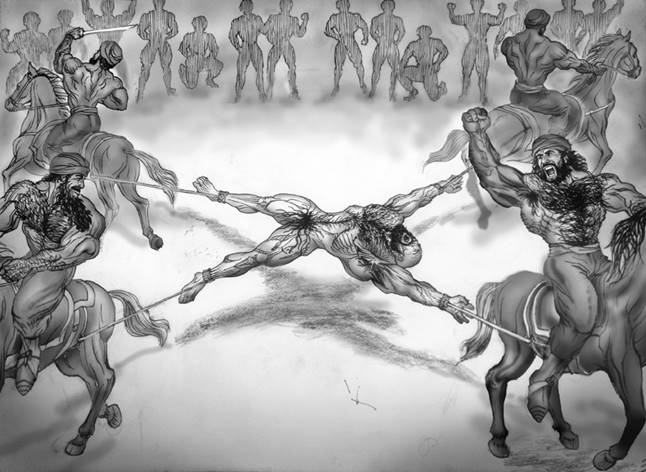
his face to keep him from slipping away. Four horses are lined up, already jittery
from the noise and the smell of blood. The city’s men-at-arms tie each
of Ferdinando’s limbs to a separate horse, using thick, rawhide ropes.
The executioner stands over him, sweating, sucking his teeth. The bishop and
his retinue watch from a platform, faces hidden behind veils. The priest
hovers close, reading psalms in a hurried monotone. A trumpet sounds. The horses are whipped.
At first, nothing—Ferdinando is too big, too tough—but then the
ropes grow taut, his arms and legs stretched out at impossible angles. The
pain is beyond pain now, a new country made of white fire. He tries to
scream, but only a thin wheeze escapes. The horses pull again. The crowd howls.
One of Ferdinando’s arms pops loose, tendons and veins snapping in a
bright red spray. The other arm follows, then a leg. He’s still alive
when the last limb is torn off. His torso shudders on the stones, a
butcher’s stump. The executioner steps forward, hacks off
the last leg with three hard strokes of the axe, then saws through
Ferdinando’s neck. The head comes away, mouth frozen open, tongue
lolling. The crowd surges forward, desperate to
see. Some scramble for scraps of flesh as souvenirs. “May God have mercy on his
soul,” the priest intones. The bishop nods. “Bring out the
next.” They bring out Bertrand, already
stripped, arms pinioned behind his back. He walks under his own power, jaw
set, face unreadable. He glances once at Ferdinando’s remains, then
looks up at the sky. The executioner and his assistant castrate him quickly,
with almost professional boredom, and let the blood pour. The crowd barely
notices; they’re still chewing over the first kill. Bertrand is tied to the horses just like
Ferdinando. He spits at the bishop’s feet and shouts, “Cowards!
Hypocrites! Jerusalem will burn, and you’ll die screaming!” The trumpet sounds again. The horses
lurch. Bertrand’s body comes apart faster, flesh and bone surrendering
with a sickening rip. The platform clears, the bishop leading his
retinue away. The priest lingers only long enough to splash holy water on the
blood. The city’s crowd, sated and
exhausted, disperses. The executioner wipes his hands, looks up
at the empty sky, and laughs. For two days, Jerusalem celebrates. Ferdinando’s right arm hangs from a
butcher’s hook in the bazaar, a blackened fist curled around nothing.
His left is nailed to the cathedral door, the blood marking the entryway like
a signature. One of his legs dangles from the city’s highest tower, a
warning to any who think to run. Bertrand’s remains are scattered just
as wide—one arm at the brothel, the other in a goldsmith’s
window, the feet tossed to the leper colony outside the walls. The heads are the real trophies.
They’re mounted on iron spikes at the eastern gate, eyes staring out at
the road to Damascus. Flies swarm them before noon. By nightfall, the flesh
goes green, then gray, the eyes eaten away by wasps. Children make bets about
which head will rot away first. On the third morning, the guards gather
up the torsos and limbs, cart them out to the city’s ancient sewers,
and dump them in with a splash. Rats and worms do the rest. But the heads
stay on their pikes, grinning at the sunrise, until even the bishop
can’t stand the stench. When Saladin enters the city two months
later, he finds the pikes still standing, the heads barely more than skull
and scalp, hair twisted in the wind. His men pull them down, toss them into
the same black hole as the rest. |